Repairing Sound Suppression Tires on Electric Vehicles | FAQs
Q1: What are sound suppression tires and why are they used in electric vehicles (EVs)?
Sound suppression tires are specifically designed with an internal layer of sound-absorbing foam applied to the tread area. They were developed in response to the increased audibility of tire noise within the cabin of electric vehicles. Unlike traditional combustion engine vehicles, EVs lack engine and transmission noise, making tire noise, caused by tread pattern harmonics, a more prominent source of interior sound.
Q2: Which tire manufacturers offer sound suppression technology and what are some of their brand names for it?
Several major tire manufacturers produce sound suppression tires. Some examples include: Michelin (Acoustic Technology), Continental (ContiSilent), Bridgestone (B-Silent), Goodyear (Sound Comfort), Dunlop (Noise Shield), Hankook (Sound Absorber), and Pirelli (PNCS – Pirelli Noise Cancelling System). These manufactur-ers often include specific markings or symbols on the tire sidewall to indicate the presence of the sound suppression foam.
Q3: Are sound suppression tires repairable?
Yes, sound suppression tires are generally repairable using the same industry-approved methods for injury size and location as standard tires. However, it is crucial to check with the specific tire manufacturer to confirm repairability for their particular tire model. If the manufacturer advises against repair, then a repair should not be attempted.
Q4: What are the key differences in repairing a sound suppression tire compared to a regular tire?
The primary difference lies in the presence of the sound suppression foam and its adhesive. Before performing a repair, the foam in the injury area must be carefully removed to allow for proper inspection and application of the repair materials. There are two main types of adhesives used to secure the foam: cured (dry to the touch) and uncured (tacky to the touch), and the removal process differs slightly between them.
Q5: What special considerations are necessary when repairing a sound suppression tire with uncured adhesive?
When dealing with uncured adhesive, it must be thoroughly removed from the injury area using a specialized adhesive remover and a low-speed buffer (not exceeding 2,800 RPM). It is important to periodically clean the adhesive remover tool to maintain its effectiveness. Unlike standard tire repairs, pre-buff cleaner and tire scrapers should not be used initially on the inner liner of tires with uncured foam adhesive.
Q6: How is the sound suppression foam handled during the repair process?
Regardless of the adhesive type, the sound suppression foam must be cut and removed around the in-jury area (typically 2 inches on each side of the puncture path, for a total of 4 inches of foam removal). Once the repair is completed, REMA TIP TOP, does not recommend rein-stalling the removed foam.
Q7: Are standard tire repair procedures still followed for sound suppression tires after the foam is removed?
Yes, once the sound suppression foam and its adhesive are properly removed from the injury area, the subsequent steps of the tire repair process follow stand-ard industry procedures. This includes identifying the angle of penetration, preparing the injury channel (buffing and using a carbide cutter), and installing either a one-piece mini-combi repair or a two-piece repair, adhering to the same limitations on injury size and loca-tion as with any other passenger tire.
Q8: What final steps are required after repairing a sound suppression tire?
After completing the repair, the area should be inspected for any defects like peeling or lifting. A gen-erous application of inner liner repair sealant should be applied to the over-buffed area and the edges of the repair unit. The tire should then be remounted on the wheel, inflated to the recommended pressure (checking TPMS), balanced, and inspected once more before being put back into service. The vulcanization of the repair unit occurs naturally under normal driving conditions.
Q9: Which kit should be used when repairing a sound suppression tire with adhesive foam?
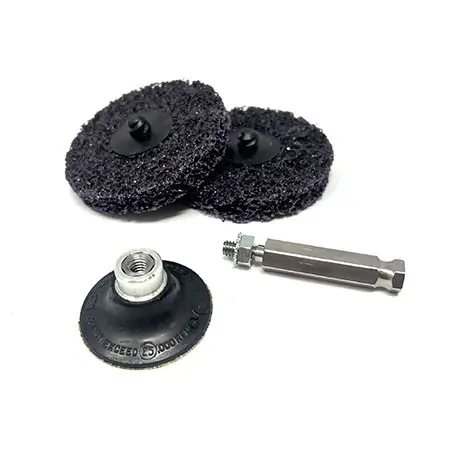
For optimal results when repairing sound suppression tires, REMA TIP TOP Part #71524 EV Tire Adhesive Removal Kit should be used. This kit allows technicians to quickly and easi-ly remove the adhesive that holds the sound-insulating foam in place on EV tires. To reach the inner liner and perform a proper repair, the adhesive must first be removed. The EV Adhesive Removal Kit significantly reduces adhesive removal time from 20 minutes to just 5 minutes, all without introducing harmful chemicals, solvents, or unrecognized methods into the repair process. It’s a safe, efficient, and OEM-compliant solution for ser-vicing sound suppression tires. EV Tire Adhesive Removal Kit includes: Two (2) x 3” Roloc Discs; One (1) x Quick Change Adapter [2,500 – 2,700 RPM]; and One (1) x 2″ Holder.